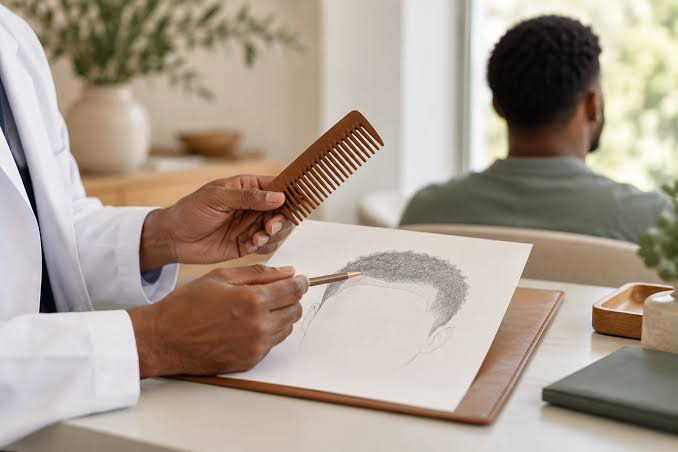

The beauty industry has spent years learning that textured hair is not a niche. Salons, product lines and styling education have all had to catch up with a customer base that was underserved for a long time. Hair restoration is going through a similar shift. A growing number of men and women with afro-textured hair are asking about transplants, and many are finding that the standard advice written for straight hair does not fit their situation.
This article looks at the topic from a beauty and grooming angle: what makes afro-textured hair different in a procedure, how to think about planning and price, and which questions separate a careful provider from a careless one.
Why afro-textured hair needs a different plan
Afro-textured hair grows from follicles that are curved beneath the skin, rather than running straight down. That curl affects almost every step of a transplant. When a follicular unit is extracted, the curved root has to be followed accurately, otherwise the graft can be damaged or cut. The extraction tools, the angle of approach and the spacing of punches all need adjusting. A technician or doctor who mostly works on straight hair may not have developed that feel.
There are also benefits that come from the same curl. Tightly coiled hair tends to give a fuller look from fewer strands because each hair takes up more visual space as it curves. That is one reason plans for afro-textured hair can look different from plans for straight hair, and it is why the count of grafts is not something to copy from a friend with a different hair type.
Scarring and healing considerations
Some people with afro-textured skin and hair are prone to keloid scarring or noticeable marks in the donor area. This is a conversation to have openly before any procedure. A good consultation will include questions about how you have healed after past cuts, piercings or injuries, and the team may recommend a test approach or a more careful technique if there is a history of raised scars. Not everyone is a suitable candidate, and an honest provider will say so.
This is also a point on which results vary. Skin type, aftercare and individual healing all play a part, and nobody should promise how a particular scalp will respond.
Reading a quote properly
Price is where most people start, and it is also where most confusion begins. A figure on its own does not tell you how many grafts are included, which technique is used, who performs the work or what support exists afterwards. If you are building a budget, a guide to what an afro hair transplant costs can help you understand which factors move the price, from the size of the area to the technique chosen.
As a reference point, Turkey Hair Center publishes four packages that range from $2,550 to $4,500. Where a case sits within that range depends on the plan agreed after assessment, not on a standard rate.
Questions to ask before you book
Whether you are researching for yourself or for a client, friend or family member, the following questions are worth putting in writing and keeping the answers.
- How many afro-textured cases does the team plan and perform, and can they explain their approach to curled follicles?
- Will you see a hairline design before the procedure, and can you ask for changes?
- Who exactly performs the extraction and implantation, and where?
- What is the plan for the donor area, and how will density be protected for future sessions?
- What aftercare instructions come with the package, and who answers questions after you fly home?
- What happens if you want to adjust the plan on the day?
A provider that answers these clearly and without pressure is showing the kind of transparency that matters more than any discount.
Hairline design is a grooming decision too
Beauty professionals know that a good cut is about proportion, and the same applies to a transplant. A hairline that is too low, too straight or too sharp can look unnatural on any hair type, and on afro-textured hair it is easy to overdo the edge-up effect. A natural hairline is slightly irregular and softer at the edge. It should also look right at fifty, not only at thirty. Bring clear photos of how you wore your hair in the past, and be ready to discuss how you style it now, whether that means short fades, twists, locs or longer natural styles, because the plan should support the way you actually wear your hair.
Beard and eyebrow work follow the same logic. Facial hair is often planned separately, with its own direction and density, and some people consider an eyebrow transplant alongside scalp work. Women with thinning along the hairline or parting, including from traction-related loss, should also ask whether the provider has a dedicated approach for them, since the planning is not the same as for men.
Preparing for the trip and recovery
For anyone travelling for a procedure, the practical details matter. Ask how many days you are expected to stay, what the first nights should look like, how to sleep, when you can wash your hair and what to avoid in the first weeks. Aftercare is instruction from the medical team, and following it carefully is part of the result. Many people plan time off before returning to work and avoid tight hats, heavy sweating and certain styling products until told it is safe.
Texture can also change how the early phase looks. Newly implanted hairs often shed within a few weeks before regrowing, and tightly coiled hair can take time to show its full density. Patience is part of the process.
Where to start
Begin with photos, a list of questions and a clear idea of your goals. Then compare providers on process and transparency, not only on cost. Turkey Hair Center is an Istanbul-based company authorised by the Ministry of Health for health tourism, with ISO 9001 certification, and its own team performs the procedures in partner hospitals and polyclinics in Istanbul. It offers FUE, sapphire FUE and DHI, as well as eyebrow transplants, procedures for women and treatment for afro-textured hair. You can read more at https://turkeyhaircenter.com/.
As with any medical procedure, a consultation decides whether treatment is suitable, and the medical team’s aftercare guidance should be followed closely. Take your time, ask the awkward questions and choose the plan that fits your hair, your skin and your life.