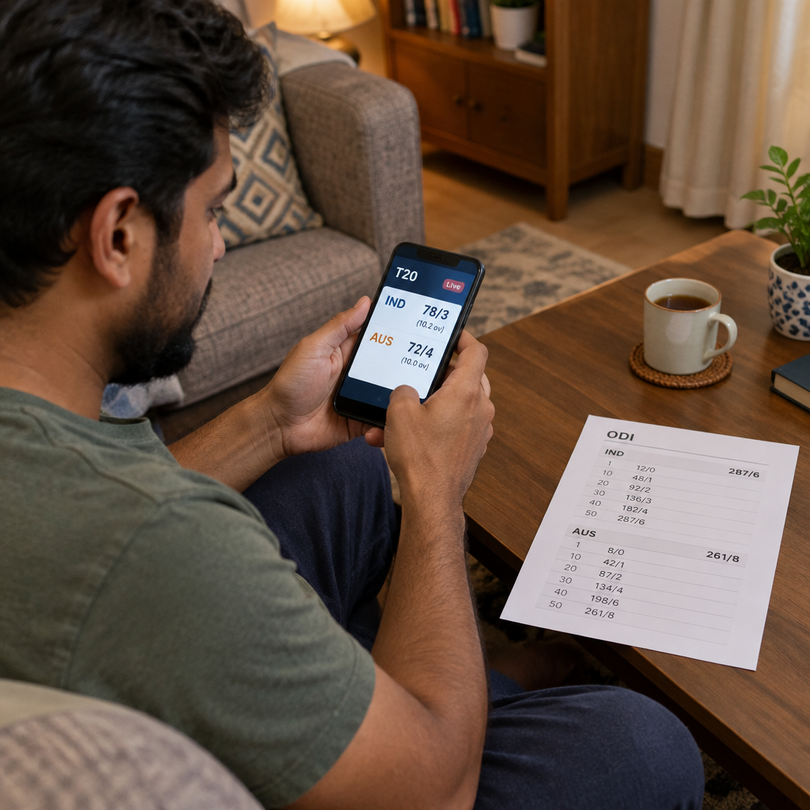

Two formats, different rhythms
A fan who follows one limited-overs format closely will feel the ground shift when they open a betting market from the other one. A total of 280 can be competitive in an ODI and would be exceptionally high in a T20.
T20 vs ODI betting turns on how much time remains after each turning point. Reading prices in a desi instant games casino calls for that distinction. Match-winner markets reflect the scope for recovery. Innings-total markets reflect how scoring opportunities change across the innings.
A side losing two wickets inside the powerplay has more time to rebuild in a 50-over match, while in a T20 the shorter recovery window can sharpen the move in the match-winner price. The match rules are familiar to you; the way markets react to them is the part that has to be learned separately.
Innings-total markets reflect how scoring opportunities change across the innings.
The safest habit, and the one this whole piece builds towards, is to read pace, recovery time and market movement within the format rather than carrying assumptions across.
Powerplay pressure
The opening restrictions are the cleanest illustration of why the two formats price differently. In a T20, the first six overs allow only two fielders outside the 30-yard circle, a 36-ball phase in which field placement can affect scoring.
In an ODI, the same restriction runs for ten overs, after which 40 overs of batting remain, so the powerplay occupies a smaller share of the scheduled innings.
For innings-total lines, that means early boundary frequency can have a sharper impact on the projected T20 total. ODI totals are built in phases, and the first ten overs are a foundation rather than the structure. Match-winner markets reflect this too: a strong T20 powerplay can move prices noticeably, because six overs account for 30% of the side’s scheduled innings.
Middle overs matter
The middle phase is where the formats diverge most. ODI cricket, from roughly over 11 to 40, permits a wider field and rewards accumulation – singles, rotated strike, the odd release shot.
After the ODI powerplay, 40 scheduled overs remain, giving a chasing side more scheduled time to absorb a quiet stretch than a T20 side has after its six-over powerplay.
T20 middle overs allow up to five fielders outside the circle, so a chasing side faces a sharper trade-off: risk wickets for boundaries or let the required rate rise. With up to five fielders outside the circle, the batting side has a sharper trade-off between preserving wickets and finding boundaries.
A short quiet spell uses a larger share of a T20 innings than an ODI innings, so it can alter the match balance more sharply.
Wickets move different odds
Consider the same event in both formats: the number three batsman is caught at deep midwicket in the 18th over. In a T20, that leaves fewer than three overs to recover – live match-winner prices can move sharply with little batting time left.
In an ODI, the same dismissal in the 18th over leaves roughly 32 overs, giving a settled middle order much more time to rebuild.
The arithmetic is the point: each side has 120 scheduled deliveries in a T20, compared with 300 in an ODI. A six-over T20 powerplay is a larger share of the innings than a ten-over ODI powerplay, even though the latter lasts longer in deliveries.
The relevant market question is how much scheduled batting time remains, not whether an early-over event occurred in both formats. Even then, the target, score, wickets in hand and batting depth determine whether that extra time is practically useful for a rebuild.
The comparison therefore focuses on scheduled time and phase, not on an assumption that wickets or boundaries have the same value in every match. A T20 side has less time to recover, so a wicket can carry extra weight when few overs remain.
An ODI side may have time to rebuild after a two-wicket spell, but the price response still depends on who falls, the batting depth and the scoring task.
Reading total lines
Innings-total markets deserve their own comparison, because the two formats construct a total differently enough that even experienced readers misjudge them.
| Aspect | T20 innings | ODI innings |
| How the total builds | Boundary hitting and strike rotation within a short innings | More time for consolidation before a final push |
| Weight of the powerplay | 30% of the scheduled innings | 20% of the scheduled innings |
| Changing conditions | Surface pace and dew can affect scoring | A longer match gives conditions more time to change |
| Reading live totals | A short burst uses a larger share of the available overs | More overs may remain to offset a brief scoring burst |
The practical takeaway is that a T20 total line responds to scoring bursts within a shorter window, while an ODI line projects how the side may balance consolidation and acceleration. Pitch reports matter in both, while changes in surface pace, dew or weather can alter the scoring outlook as a longer match unfolds.
Pre-match price inputs
Pre-match pricing leans on different evidence for each format. T20 assessment can weigh recent form and immediate conditions alongside a longer record, because short matches leave individual results especially exposed to brief swings. A team’s last handful of T20s is best read alongside its longer record and any changes in personnel or conditions.
Squad depth, all-round balance and middle-overs reliability matter in ODI cricket, since a 50-over match tests endurance and bowling variety across a much longer arc.
If you follow one format’s team news closely, expect your intuition to be only partly transferable to the other – a star T20 finisher and a proven ODI accumulator are not the same asset, even in the same jersey.
Live market discipline
In-play reading is where format awareness pays off most, and where discipline matters. A few points worth keeping in mind:
- T20 momentum can turn inside two or three overs; interpret a price change against the runs, wickets and share of the innings used in that spell.
- An expensive over early in an ODI leaves more time for recovery than one near the finish, so read the price shift alongside the overs remaining.
- After early ODI wickets, read the new price against the remaining batting depth and scoring task; extra overs offer rebuilding time, but the dismissed batters still matter.
- Required-rate thresholds behave differently: seven an over at the T20 death is generally modest, while sustaining it over a long ODI chase can be demanding.
None of this tells you when to stake money; it tells you what a moving price is actually describing. If you mainly watch one format, calibrating this by simply watching the other format’s markets without acting is a sensible way to learn.
Market interpretation summary
The core of T20 vs ODI betting is not that one format is riskier than the other – it is that the same market vocabulary describes different recovery windows. Match-winner prices in a T20 can respond sharply when an event leaves little recovery time; in an ODI, the same event may leave more overs for the batting side to rebuild.
Innings totals in both formats reflect scoring pace and wickets, but the shorter T20 innings gives each burst or setback a larger share of the available time. Read pace, wickets and totals within the format you are looking at, and the two formats stop feeling like the same game with different numbers.