
How to Choose the Best Everyday Carry Flashlight for Practical Use
What’s the one tool you reach for more often than you’d expect, yet rarely think about until you actually need it?
For me, it’s a flashlight. Not the dusty one rattling around in a kitchen drawer, but the one that lives in my pocket or bag every single day. I learned this the hard way a few years back during a power outage in my apartment building. I had candles, sure, but when I needed to check the breaker panel in a pitch-black basement corridor, a flame wasn’t going to cut it. I fumbled with my phone’s flashlight, nearly dropped it twice, and realized I was holding a fragile glass slab over a concrete floor. That night pushed me down a rabbit hole I never expected to fall into: the world of everyday carry flashlights.
Since then, I’ve tested dozens of lights, from budget keychain models to premium tactical torches, and I’ve made plenty of buying mistakes along the way. The good news is that choosing a practical EDC flashlight isn’t complicated once you understand a few core principles. Let’s walk through them together.
Start With How You’ll Actually Use It
The biggest mistake I see people make is buying a flashlight based on specs alone. A 5,000-lumen monster sounds impressive, but if it’s the size of a soda can, you’re not going to carry it daily. Conversely, a tiny keychain light that dies after twenty minutes won’t help in a real emergency.
So before you look at a single product page, ask yourself a few honest questions:
- Where will this light live? Pocket, bag, keychain, or car?
- What’s the primary scenario? Walking the dog, inspecting equipment, camping, or emergency preparedness?
- How often will you use it? Daily, weekly, or just in case?
Your answers will narrow the field dramatically. A keychain light makes sense if you want zero fuss, but a pocket clip model gives you more power and runtime without much extra bulk. If you’re often outdoors at night or working in dim environments, a slightly larger light with better heat management is worth the trade-off.
For example, if you browse a retailer like this website that carries a range of EDC gear, you’ll notice flashlights come in wildly different shapes and sizes. That variety exists because there is no single “best” light — only the best light for your specific needs.
Lumens Aren’t Everything (But They Matter)
New buyers tend to fixate on lumen count, and I get it. Brightness is easy to market. But lumens only tell part of the story, and chasing the highest number can actually hurt your experience.
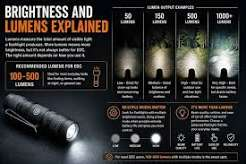
Here’s the thing: most everyday tasks need far less light than you’d think. Finding a keyhole, reading a menu in a dim restaurant, or checking under a car hood usually calls for somewhere between 50 and 300 lumens. Crank that up to 1,000 lumens in a small room and you’ll blind yourself with bounce-back glare.
What matters more is how the light is distributed. A focused beam (throw) is great for spotting things at a distance. A wide beam (flood) is better for close-up work and illuminating a whole area. Many practical EDC lights offer a balanced beam or adjustable focus, which is why I usually recommend those for first-timers.
Also pay attention to mode spacing. A good light offers a low mode for preserving night vision and battery, a medium mode for general use, and a high mode for when you really need it. If the jump from low to high is jarring, or if the light always starts on its brightest setting, that’s a usability problem you’ll notice every single day.
Runtime, Battery Type, and Rechargeability
A flashlight is only as useful as its power source. This is where a lot of cheap lights fall apart — they claim big numbers but can’t sustain them for more than a minute or two.
Look for runtime figures that specify which mode they apply to. “Up to 30 hours” usually means the lowest setting, which is fine, but you should know that going in. A practical EDC light should give you at least a few hours of usable medium output.
Battery type is another big decision:
- Disposable batteries (AA or AAA): Easy to find anywhere, but you’ll constantly buy replacements, and performance is limited.
- Lithium-ion rechargeable (like 18650 or built-in cells): Higher performance, lower long-term cost, but you need to remember to charge them.
- Hybrid options: Some lights accept both, which is great for travel and emergencies.
I personally lean toward USB-C rechargeable lights for daily carry. There’s something reassuring about topping up your flashlight with the same cable you use for your phone. But if you want a light that sits in a glovebox for years and still works, a lithium primary or AA model might serve you better.
Build Quality and Durability
Your EDC light is going to get knocked around. It’ll ride in pockets with keys, get dropped on pavement, and maybe spend a night in the rain. Build quality isn’t a luxury here — it’s a requirement.
Look for:
- Aircraft-grade aluminum or titanium bodies with a decent anodized finish
- IPX ratings for water resistance (IPX4 handles splashes, IPX8 survives submersion)
- Impact resistance ratings, usually expressed in meters
- A quality pocket clip that won’t bend or snap
I’ve had budget lights fail because the switch gave out after a few months of pocket carry. Saving ten dollars upfront isn’t worth a tool that quits when you need it most.
The User Interface Matters More Than You Think
This is the most underrated factor in flashlight buying, and it’s the one that separates a light you love from one you tolerate.
Ask yourself how the light turns on and off. Does it use a tail switch, a side switch, or a twist mechanism? Can you operate it one-handed? Does it have a momentary-on feature? Can you lock it out so it doesn’t accidentally activate in your pocket?
A confusing interface turns a powerful tool into a frustrating puzzle, especially in the dark. The best EDC lights are intuitive from the first press. If you have to consult a manual to cycle through modes, that’s a red flag.
A Few Personal Recommendations by Category
Since everyone’s needs differ, here’s how I’d break down the field:
- For minimalists: A compact keychain light with a built-in battery. It won’t light up a field, but it’s always with you.
- For daily pocket carry: A single 14500 or AA-powered light with a pocket clip. Slim, capable, and easy to feed.
- For versatility: An 18650 or 21700-powered light with multiple modes and USB-C charging. This is my personal sweet spot.
- For emergencies and travel: A light that runs on common batteries and has a long low-mode runtime.
There’s no shame in owning more than one. In fact, most experienced EDC folks do — a small one for the pocket, a bigger one for the bag.
Don’t Overthink It, But Don’t Underthink It Either
If you take nothing else from this, remember that a practical flashlight is one you’ll actually carry and use. Brightness, battery, build, and interface all matter, but they matter in relation to your life, not in the abstract.
Start with your real needs, set a budget you’re comfortable with, and don’t be afraid to start modest. My first “real” EDC light wasn’t fancy, but it taught me what I valued, and every purchase since has been smarter because of it.
The best flashlight isn’t the one with the biggest numbers on the box. It’s the one that’s in your pocket when the lights go out.