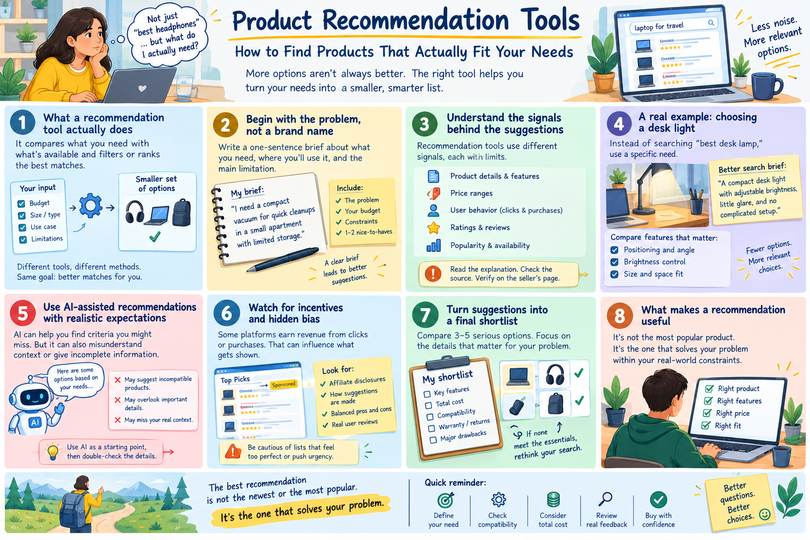

Online stores are excellent at showing us what exists. They are not always as good at helping us explain what we need. A search for “best headphones,” for example, can return hundreds of products, sponsored placements, ranked lists, and customer opinions that disagree with one another. The information is plentiful; the decision is still difficult.
Product recommendation tools aim to close that gap by turning a user’s requirements into a smaller set of possibilities. But different tools work in different ways, and not every recommendation deserves equal trust. Understanding how these systems narrow choices helps shoppers use them more effectively.
What a recommendation tool actually does
At its simplest, a recommendation tool compares information about the shopper with information about available products. The shopper might provide a budget, preferred size, intended use, or a specific limitation. The tool then filters or ranks possible matches.
Some systems depend heavily on previous clicks and purchases. Others ask direct questions about the problem a person is trying to solve. Still others blend catalog information, popularity signals, and automated descriptions. These approaches can all be useful, but they answer slightly different questions.
“People like you bought this” is not the same as “This may fit your particular requirement.” Someone buying headphones for a noisy train journey has different priorities from someone recording voiceovers at home, even if both shoppers start with the same keyword.
Begin with the problem, not a brand name
Before opening a recommendation tool, write a one-sentence description of the job the product needs to do. Include the setting and the main limitation.
Instead of “I need a vacuum,” try “I need something manageable for quick cleanups in a small apartment with limited storage.” Instead of “I want a monitor,” try “I need a second screen for documents and video calls on a narrow desk.”
This turns a general category into a practical brief. If the product does not address that brief, it should not make the shortlist, regardless of how many positive reviews it has.
A useful brief usually includes four details:
● The problem you want to solve.
● Your maximum comfortable budget.
● Any non-negotiable constraints, such as size or compatibility.
● One or two features you would like but could live without.
Understand the signals behind the suggestions
Many recommendation systems use product descriptions, attributes, price ranges, user behavior, and ratings. Each signal has limitations. A highly rated product may have reviews from people using it in very different conditions. A popular model may be widely available rather than uniquely suitable. An advertised feature may sound impressive while making little difference to everyday use.
Look at the explanation for each suggestion. Does the tool show why a product matches your need? Can you compare relevant features? Can you understand what has been left out? A recommendation without enough context is a prompt to research further, not a final answer.
Also remember that catalogs and prices change. Verify the specifications and any commercial claims on the seller’s current product page before making a purchase.
A practical example: choosing a desk light
Suppose you want a lamp for reading and computer work in a shared room. Searching for the “best desk lamp” may surface decorative models, large studio lights, and premium smart devices.
A better search brief is specific: “A compact desk light with adjustable brightness, little glare, and no complicated setup.” You can then check whether the shortlisted products actually offer suitable positioning, controls, and dimensions.
Notice what changes. Instead of comparing ten unrelated best-seller lists, you compare a handful of features that affect the job. The final choice might be a modest lamp rather than the most expensive smart model.
Use AI-assisted recommendations with realistic expectations
AI can help translate an ordinary-language problem into useful criteria. It may identify needs you had not considered or explain why two features matter differently. But automated suggestions can also misunderstand context, overlook compatibility issues, or rely on incomplete information.
For example, an assistant might recommend a device with a connector that your existing equipment does not support. Or it might confidently describe an optional accessory as included. Treat these suggestions as starting points for a shortlist, and check the underlying details independently.
A problem-first service such as ProblemPick illustrates a useful browsing approach: begin by stating the problem and exploring products through the lens of that need, rather than starting with a brand or a giant marketplace category. As with any shopping aid, verify the final product information before buying.
Keep an eye on incentives and hidden bias
Some recommendation platforms earn revenue when shoppers click or purchase. That business model is common, but readers should know when commercial relationships could influence the order or selection of products.
Look for clear affiliate disclosures and explanations of how suggestions are produced. Be cautious of lists where every item is described as perfect, disadvantages are absent, or urgency claims push you toward immediate checkout. Strong recommendations explain who a product suits—and who it does not.
Independent reviews, manufacturer documentation, and retailer policies all have roles in the process. None should be treated as the sole source of truth.
Turn suggestions into a final shortlist
Once you have options, compare no more than three to five serious candidates. Record the features tied to your original problem, total cost, compatibility, warranty, and any significant drawback. Ignore minor differences that will not matter in everyday use.
If two products are equally capable, prefer the one with clearer support information or fewer unnecessary compromises. If none meets the essentials, revisit the search instead of buying the least unsuitable item.
What makes a recommendation useful
Product recommendation tools are most valuable when they reduce noise rather than create a new kind of advertising. Start with a clearly defined need, understand why each suggestion appears, and verify the details that affect your decision. The best recommendation is not necessarily the most popular product. It is the one that solves your particular problem within your real-world constraints.