
Customer relation is the soul of modern business. Yet, it has to be carried out in an organized manner, which should be consistent, reliable, and responsive. Interactive Voice Response (IVR) is one of the areas that has become critical in customer communication.
With the SaaS industry and the globalization effort increasing customer expectations, the need for a more automated, personalized, and innovative approach to call handling is never more urgent. An efficient IVR system can then be used to create efficient call routing, resulting in a significant reduction in waiting time and an improvement in customer satisfaction, without needing increased staffing or shorter working hours.
The article will discuss the significance of IVR, its development history, key elements, best practices, issues associated with its use, and its place in the current customer service model.
What Is Interactive Voice Response (IVR)?
Interactive Voice Response (IVR) is an automated telephony technology that enables individuals to handle a business’s phone system without talking to a real agent immediately. Instead, the customers utilize voice commands (such as saying Billing or Check balance) or keypad commands (pressing the numbers) to navigate between menu items.
An IVR system will welcome a user with recorded greetings or AI-generated messages when a person calls a business. It also walks them through menus and allows them to retrieve information to accomplish a task or reach a specific department or agent.
One such option is IVR, and it may enable customers to make payments, look at the status of their orders, book an appointment, or view their account data without going through the queue.
The Evolution of IVR
IVR has evolved largely since its infancy. The earliest systems were based on keypad interfaces (DTMF tones), with the caller dialling numbers to navigate long menu tree structures, which is generally a frustrating experience. The IVR with pre-recorded voice prompts was first introduced in the 1990s and can be used to perform simple self-service activities, such as checking balances or order tracking.
The most significant jump was that of AI, speech recognition, and natural language processing (NLP). Customers do not need to dial numbers anymore since they can just state, I want billing assistance and the IVR comprehends. Nowadays, the latest IVR is being integrated into CRMs, omnichannel, and cloud phone systems to communicate customized experiences.
Rather than only routing, it can now be used in surveys, payment, appointment-setting, and notifications in real-time. IVR is getting more intelligent, conversational, and predictive as it evolves to define the future of customer communication.
This is another example of the hidden power of technology in business that drives real growth, where even an introductory call can be turned into a personalized, data-driven interaction. Learn more by tapping here.
Key Components of IVR Systems
An IVR system comprises a number of fundamental components that, when together, form an efficient and easy working caller experience. All the parts make sure that customers get precise information or are directed to the respective department without wasting time.
1. Call Routing Engine
The routing engine is the resource allocator of IVR. It refers them to the correct department or agent based on their input. High-tech systems even apply skills routes, whereby the customer is connected with an agent who has the skills to address the problem.
2. Voice Recognition & DTMF
The customers can engage with IVR using two approaches, which include voice commands or keypad (DTMF). Whereas previous telephone systems used only keypad clicks, the modern IVRs incorporate speech recognition and even NLP to interpret the requests in a natural language, thus ensuring the interaction is faster and more natural.
3. Menu & Prompts
Menus and prompts provide the IVR voice. They direct the callers with definite directions and alternatives, either in pre-recorded or AI. Clear and well-organized menus make customers quickly find their way since they know what they are doing and where it is with minimal effort.
4. Integration Layer
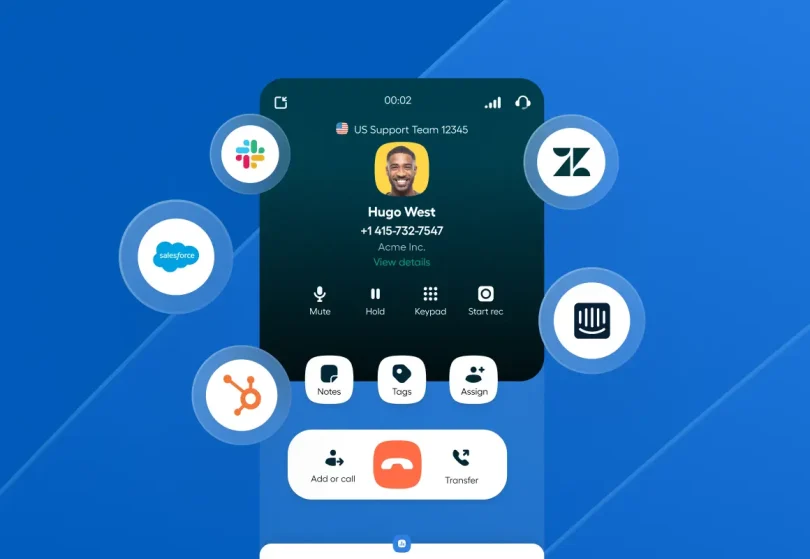
This links IVR with the rest of the business systems, such as CRMs, ticketing, or database platforms. Where integration is implemented, the IVR can optionally generate real-time information. Let’s say a bank customer can hear their bank balance, or a flight traveler can be advised of their flight status without dialogue with an agent.
5. Analytics & Reporting
Analytics give us an idea of how customers operate through the IVR. When the call flows, menu selections, wait times, and drop-offs are tracked, then areas of problem can be detected and the system can be improved. With time, this makes the IVR more effective and convenient to customers.
Why Is IVR Important in Customer Communication?
IVR is of immense importance in the VoIP phone system in the contemporary era, where companies have to deal with high volumes of incoming calls. It takes the strain off of agents, improves customer experiences, and makes them fast, uniform, and accessible anywhere.
If you use an IVR feature, then it’s essential to learn how it benefits your VoIP. Let’s learn them real quick.
I. Reduced Response Time
IVR eliminates wastage through directing customers into the appropriate department or resource, thus avoiding any transmissions. This reduces call handling time, eliminates long queues, and provides enough help to the customers, hence increasing their experience with the call centers and their efficiency.
II. Cost Reduction
IVR reduces the burden on the human workforce by automating marginal activities that include checking a balance, updating an order, or confirming an appointment. This enables the businesses to cut on staffing expenses, although they can receive a high number of calls and still offer quality service with consistency.
III. 24/7 Availability
Unlike those of the human agents, IVR systems never sleep, and they can be used to assist even when business is not operational. Customers will be able to do all required tasks at any time, such as checking account details and making transactions, which can provide businesses with a competitive advantage since it is always available and reliable.
IV. Personalization
The latest IVR systems are connected to CRMs in order to refine the interactions. Customers may be welcomed by name, offered something appropriate to them, or directed depending on their past. This brings about a customized experience that is more interesting and leaves less frustration and more fulfillment.
V. Improved Satisfaction
IVR gives customers self-service, where they can always find solutions to common issues without involving customer care. At the same time, it makes sure that complex concerns will be escalated to human agents. This combination of automated features and human assistance causes higher rates of solutions and satisfied clients.
Best Practices for IVR Implementation
The key to obtaining maximum value out of IVR is to create it in a manner that is efficient and accommodating to the consumer. IVR should be structured tactfully such that communication flows with ease, whereas an ill-thought-out one can be irritating to a customer. These are some of the best practices:
1. Make Menus Short
IVR menus must be concise and specific, with 3-5 choices on each level. Multi-tiered menus complicate and frustrate callers, leading to high call abandonments. A straightforward process assists in getting customers where they want to be in the quickest time possible
2. Visible cues
Prompts are the guidelines of the caller. Messages must be short, polite, or non-technical. Clear instructions eliminate errors and prevent customer loss in the system, making interactions smoother and increasing satisfaction.
3. Offer Self-Service
Automation is one of the most significant advantages of IVR. Businesses must provide self-service options that allow customers to check their balances, track their orders, or view store hours. These are the basic services that save customers’ time while reducing the load on live agents.
4. Enable Human Escalation
Not all problems are to be resolved by means of automation. Any quality IVR must have the possibility of a connection to a live agent. This leaves clients with complicated inquiries, knowing they are not alone and can avoid dissatisfaction because they cannot use self-service.
5. Regularly Update IVR
Business processes and customer needs vary with time. Frequent reviews of prompts and menu flows make the IVR live and in use. Old messages or failures in routing can negatively affect customer confidence and decrease levels of satisfaction.
6. Use AI/Speech Recognition
AI and natural language processing (NLP) are helpful in modern IVRs. These technologies enable conversational responses, instead of requiring callers to press numbers, as in the example, “I want to know my order status.” This makes IVR quicker, less impersonal, and more natural-sounding.
If you felt curious about this modern IVR feature, then there are other cutting-edge technologies you have yet to explore. Discover the Future of Innovation with Cutting-Edge Technology to see how it eases your business operation and offers top-notch solutions.
Challenges in IVR Adoption
Although IVR is more efficient and convenient, there are some issues that companies face when integrating and using it. These include:
Too complex menus: Callers tend to get frustrated with long or bewildering menu trees, leading to higher call abandonment rates.
Bad Voice Recognition: There can be instances where specific commands can be misunderstood. Such mistakes lead to a flow breach, and customers might not feel reassured.
Lack of Personalization: There are cases where customers can be less connected to generic and standardized menus. These fail to meet customers’ needs and result in low participation.
Integration Hurdles: IVR may be technically and costly to connect to an older system or CRM.
Customer resistance: If you have a significant number of customers who prefer talking to a human being rather than going through automation, then a substantial portion of your customers will be resistant.
Conclusion
IVR has evolved significantly from its initial stages as a basic call-routing device. Leveraging automation, artificial intelligence technologies, and the ability to integrate with business systems fully, it is now a central part of the dialogue between business and customers. Contemporary IVR guarantees the speed of the response, agent overload, and a 24/7 customer approach with a certain level of personalization.
When it comes to business, efficient IVR adoption is not the only matter, but it is a competitive advantage. Organizations that take the time to invest in a well-designed IVR will reduce the cost of delivery by increasing satisfaction and providing the type of brilliant, convenient service that customers are becoming accustomed to in a digital-first world.
FAQs
How is modern IVR different from traditional systems?
New IVR involves AI, natural language understanding, and speech recognition, providing natural, conversational interaction. The conventional IVR only made use of keypad inputs, which could be exasperating to the caller due to long menus.
Which industries benefit most from IVR?
IVR is popular in the industry, with a significant number of calls, e.g., banking, healthcare, telecom, retail, and travel. These are the areas that depend on IVR to direct calls effectively, automate their anesthetic services, and ensure they offer fast customer service without any delays.
What are the key components of IVR?
Important features comprise a call routing engine, speech/DTMF recognition, prompts to assist, CRM or database integration, and analytics. All these combine to make IVR systems provide accurate information, smooth call handling, and continuous performance improvement for businesses.
Can IVR work with mobile apps or digital platforms?
In today’s modern IVR, there is integration with mobile apps, chatbots, and messaging platforms. This allows providing customers with a consistent experience across channels so that they do not have to repeat the details or lose previous conversation history when switching between phone calls and apps.
How does IVR improve customer satisfaction?
IVR improves satisfaction in terms of decreased turnaround time, 24-hour availability, and personal communication. It provides self-services that appear fast to a customer, and essential matters that are not complicated are easily accessible to a live agent when they are required.